
Why Are Paraffin Candles Bad for You? A 2026 Guide
Table of Contents
- What Paraffin Wax Is and How It Burns
- The Chemicals Released When Paraffin Candles Burn
- Indoor Air Quality and Scented Candles: What the Research Shows
- Paraffin vs Soy Wax Health Comparison: What Actually Differs
- Overwicking, Soot, and the Symptoms People Report
- Non-Toxic Candle Alternatives: What to Look For
- Frequently Asked Questions
Last Updated: September 28, 2026
What Paraffin Wax Is and How It Burns
Paraffin wax is a petroleum-based material refined from crude oil, and the question of why are paraffin candles bad for you starts with that origin. This guide from Prairie Fire Candles examines what combustion actually releases, when it matters, and how to choose better. Below, we'll show you exactly what the research says, and where the alarmist claims fall apart.
Paraffin wax is a solid mixture of hydrocarbons separated during crude oil refining, and it burns by drawing melted wax up a wick where it vaporizes and combusts. When combustion is complete, the output is water vapor and carbon dioxide. When it is incomplete, you get soot and a family of other byproducts.
The Refining Process Behind Paraffin
Crude oil is heated and separated by boiling point. The heavier fractions become lubricants and asphalt; the lighter ones become fuel. Paraffin sits in between, then goes through solvent dewaxing and filtration before it becomes the white block most candles use.
That processing removes most impurities, but it does not change the base chemistry.
What Happens During Combustion
A candle flame is a small chemical reactor. Heat melts the wax, the wick pulls it upward by capillary action, and the liquid wax vaporizes into the flame zone where it breaks down in a process called thermal decomposition.
The Chemicals Released When Paraffin Candles Burn
The chemicals released during combustion include volatile organic compounds, particulate matter, and trace amounts of benzene and toluene. These are real combustion byproducts, not marketing fiction. The honest question is how much, and under what conditions.
What Actually Comes Off the Wick
When paraffin vaporizes and hits the flame zone, incomplete combustion produces a predictable family of byproducts. The ones that show up most often in candle emission testing fall into four groups:
- Particulate matter (PM2.5 and finer). These are the solid carbon particles you see as soot. PM2.5 is small enough to reach the deep lung and is the same size fraction regulators track for outdoor air.
- Volatile organic compounds (VOCs). Formaldehyde, acetaldehyde, and acrolein are the ones most commonly cited. Formaldehyde and acetaldehyde are classified as probable or known human carcinogens at occupational exposure levels; acrolein is a strong respiratory irritant.
- Polycyclic aromatic hydrocarbons (PAHs). These form when hydrocarbons burn incompletely. Several PAHs are recognized carcinogens, though candle emissions are measured in micrograms, not grams.
- Trace aromatics. Benzene and toluene appear at very low concentrations. They are real, but the dose from a single candle is orders of magnitude below what you would get from traffic exhaust or secondhand smoke.
Why "Trace" Is the Operative Word
A common pattern in candle emission studies is that measured concentrations of benzene and formaldehyde sit near the detection limit of the instrument unless the candle is burned in a sealed, small-volume chamber. That is the key nuance most alarmist articles skip: the compound list is real, but the concentration depends almost entirely on the air volume around the flame and how long it burns.
What "Clean Burning" Actually Means in a Lab
Marketing copy uses "clean burning" loosely. In a testing context, the phrase usually maps to a few measurable metrics:
- Soot index. A laboratory burns the candle under a controlled hood and collects particulate on a filter, then reports mass per hour of burn. Lower is better; the number is what matters, not the adjective.
- Emission rate of VOCs and aldehydes. Measured in a sealed environmental chamber with a known air exchange rate, reported in micrograms per hour.
- Flame height and steadiness. A flame that stays within a target range burns more completely than one that flares and gutters.
Watch Out
Never burn a candle in a fully sealed room for hours. Combustion byproducts accumulate, and a closed bedroom with poor airflow is the worst-case scenario for any candle, paraffin or otherwise.
Scented vs. Unscented: A Different Chemical Profile
An unscented paraffin candle and a heavily fragranced paraffin candle are not the same emission source. The wax base contributes the soot and the base combustion byproducts. The fragrance load adds a second layer: synthetic musks, phthalates used as fixatives, and terpene-based aroma compounds that can oxidize into secondary irritants when heated.
Indoor Air Quality and Scented Candles: What the Research Shows
Scented candles add a second variable: synthetic fragrance. Fragrance oils can contain dozens of individual compounds, and some release additional volatile organic compounds when heated past their flash point.
Ventilation and Room Size Matter More Than You Think
A candle in a 400-square-foot open living space disperses its emissions across a large air volume. The same candle in a small bathroom concentrates them. Room size and air exchange rate are the variables most guides ignore entirely.
Paraffin vs Soy Wax Health Comparison: What Actually Differs
The paraffin vs soy wax health comparison comes down to feedstock and burn behavior, not a dramatic toxicity gap. Soy wax is hydrogenated vegetable oil; paraffin is refined petroleum. Both are hydrocarbons that combust, and both produce soot and VOCs when combustion is incomplete.
The Real Variable Is the Wick, Not the Wax
Here is the nuance most comparisons miss: the difference in emissions between a paraffin candle and a soy candle is often smaller than the difference between a properly wicked candle and an overwicked one of either type.
Where the Two Waxes Genuinely Diverge
| Factor | Paraffin Wax | Soy Wax |
|---|---|---|
| Feedstock | Refined petroleum | Hydrogenated soybean oil |
| Melt point | Higher | Lower |
| Burn speed | Faster | Slower |
| Soot tendency | Higher if overwicked | Lower, still possible |
| Scent throw | Strong | Moderate |
| Biodegradability | Limited | Good |
| Behavior in a draft | Tolerates airflow better | Can tunnel more easily |
The practical takeaway: soy's advantage is real but conditional. It depends on a properly sized wick, a reasonable burn time, and adequate ventilation. Remove any of those and the gap narrows or disappears.
Scented vs. Unscented Cuts Across Both Waxes
A fragrance-free paraffin candle and a fragrance-free soy candle differ mainly in soot profile. Add a heavy fragrance load to either, and you introduce a second set of emissions: synthetic musks, phthalate fixatives, and terpene compounds that oxidize into irritants when heated.
Beeswax and Coconut Wax: The Third and Fourth Options
Beeswax burns cleanly and carries a natural honey note, though it costs more and has a subtler scent throw. Coconut wax blends offer a strong, even throw with a lower soot profile. Both tend to command a price premium over paraffin, which is worth weighing against the modest emission difference.
Key Takeaway
The wax sets the baseline emission profile. The wick and the fragrance load determine whether you stay near that baseline or exceed it. Fix the wick and the fragrance first, then worry about the wax.
Overwicking, Soot, and the Symptoms People Report
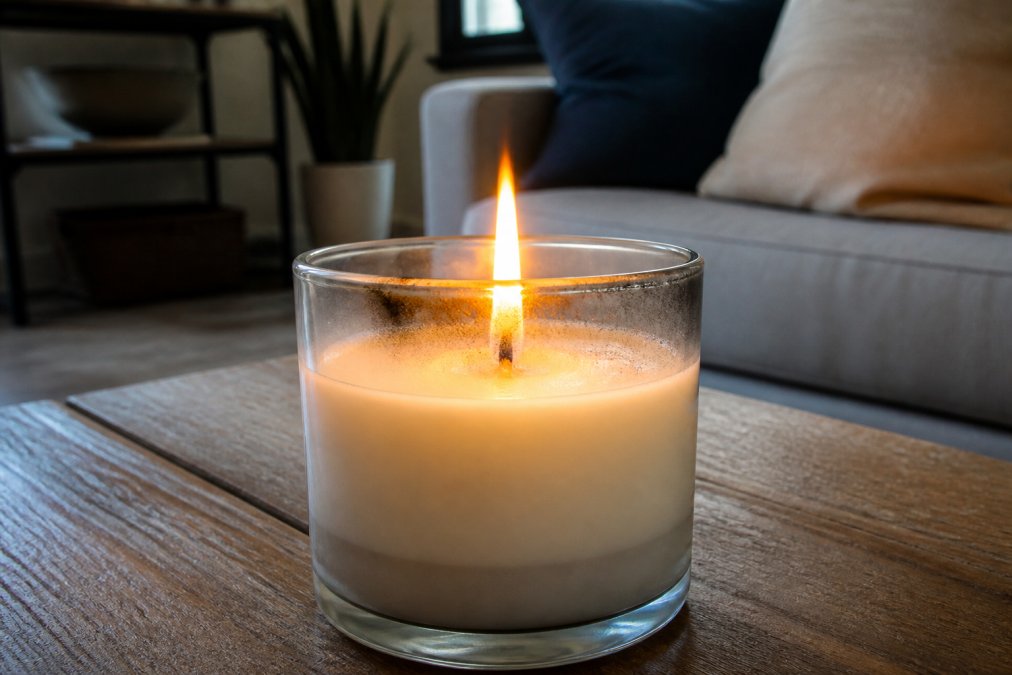
Overwicking is the single most common cause of sooty candles, and it means the wick is too large for the wax pool it has to burn. The flame pulls more fuel than it can fully combust, so it throws off black carbon particles and deposits paraffin residue on the jar rim.
Pro Tip
Trim the wick to about 6 millimeters before every burn. Most soot complaints trace back to an untrimmed wick, not the wax itself.
Non-Toxic Candle Alternatives: What to Look For
Non-toxic candle alternatives share a few traits: a natural wax base, a cotton or wood wick, and either no fragrance or fragrance from clearly listed essential oils. Read the label the way you would read a skincare ingredient list.
- Wax base is soy, beeswax, coconut, or a blend, not paraffin
- Wick is cotton, hemp, or wood, not metal-cored
- Fragrance is absent or fully disclosed
- No synthetic dyes
- Burn time and jar size are stated honestly
Frequently Asked Questions
Are paraffin candles toxic to breathe?
Burning paraffin candles releases combustion byproducts including benzene, toluene, and particulate matter. In a poorly ventilated room, these airborne pollutants can build up and cause respiratory irritation, headaches, and nausea in sensitive individuals. The risk increases with scented candles, longer burn times, and small rooms. Occasional use in a ventilated space is unlikely to cause harm for most people, but regular burning in enclosed areas is worth avoiding, especially if you have asthma, migraines, or chemical sensitivities.
Which is better, soy or paraffin candles?
In a paraffin vs soy wax health comparison, soy wax generally burns cooler and produces less soot. Soy is a natural wax alternative that releases fewer volatile organic compounds than petroleum-based paraffin. That said, soy candles with synthetic fragrance oils can still emit problematic chemicals. The cleanest option is an unscented soy, beeswax, or coconut wax candle with a cotton or wood wick. If you want scented candles, look for those made with essential oils rather than synthetic fragrance.
What should I look for when buying non-toxic candle alternatives?
Start with the wax: soy wax, beeswax, coconut wax, or a blend of these. Check the wick, since cotton and wood wicks avoid the lead core issue found in some imported candles. For scent, choose essential oil-based fragrances or go unscented. Look for third-party testing or ingredient transparency on the label. Avoid candles labeled only as 'fragrance' without further detail, since synthetic fragrance can contain dozens of undisclosed compounds. Smaller batch makers often provide more ingredient detail than mass-market brands.
How do candle emissions affect indoor air quality?
Candle emissions add particulate matter and volatile organic compounds to indoor air. In a small, closed room, concentrations can rise quickly. Ventilation and room size are the two biggest variables. Burning a candle in a large, well-ventilated space reduces exposure compared to a small bedroom with the door shut. Trimming the wick to about 1/4 inch before each burn reduces soot emission and prevents overwicking, which is when the flame draws more wax than it can fully combust.
The challenge is simple: most candle labels do not tell you the wick size, the fragrance load, or the burn behavior, and those details decide whether your candle burns cleanly. Prairie Fire Candles makes that easier with non-toxic, fragrance-free apothecary candles, handcrafted in Kansas from biodegradable ingredients and free from parabens and harmful additives. Get started with Prairie Fire Candles and bring clean-burning light into your home.
Tags:
Previous
What Fragrance Free Actually Means (And Why It Matters)
Next
Grass-Fed Beef Tallow for Skin: A How-To Guide
Related articles
Tallow Balm vs Plant-Based Oils: Which to Choose
Oct 20 2026
Primally Pure Alternative for Sensitive Skin
Oct 12 2026