
Buy Organic Grass Fed Tallow Balm: A 2026 Review Guide
Table of Contents
- Verdict First: Prairie Fire Grass Fed Tallow Balm Reviewed
- Cost Per Ounce: Comparing the 2 oz, 4 oz, and 8 oz Jars
- Tallow Balm Ingredients: What Is Actually in the Jar
- Unscented Tallow Balm for Sensitive Skin
- Tallow Balm for Face: Texture, Absorption, and What to Expect
- How to Use Tallow Balm on Face and Body
- Packaging, Shelf Life, and Storage
- Where to Buy Organic Grass Fed Tallow Balm
- Frequently Asked Questions
Last Updated: October 5, 2026
Verdict First: Prairie Fire Grass Fed Tallow Balm Reviewed
If you want to buy organic grass fed tallow balm without wading through marketplace listings, start here: Prairie Fire Candles makes the version we'd hand to a friend with reactive skin.

Here's what most shoppers get wrong: tallow balm is not a lotion. Prairie Fire's balm is organic grass-fed beef tallow from Kansas native pasture blended with cold pressed extra virgin olive oil, the entire ingredient list on the unscented version.

The brand has 199 reviews across its catalog, small enough that you can actually read them, which beats ten thousand aggregated star ratings from strangers.
Cost Per Ounce: Comparing the 2 oz, 4 oz, and 8 oz Jars
The 8 oz jar is the best value, and the gap is not small. Here is how the three sizes break down.
| Jar Size | Price | Cost Per Ounce | Best For |
|---|---|---|---|
| 2 oz | $19.99 | $10.00 | First-time trial, travel, gift |
| 4 oz | $25.99 | $6.50 | Face-only routines |
| 8 oz | $35.99 | $4.50 | Full-body use, households, repeat buyers |
The 2 oz costs more than double the 8 oz per ounce, so buy it only to test whether your skin tolerates the formula.
The 4 oz is the right pick for face-only use, since it lasts a long time at pea-sized doses.
Pro Tip
Cost per ounce is the only fair way to compare tallow balms, because jar sizes vary wildly between makers. Divide price by ounces before you compare anything, and remember that a water-based lotion at the same price delivers far less usable fat per application.
Tallow Balm Ingredients: What Is Actually in the Jar
Tallow balm ingredients in the Prairie Fire formula are organic grass-fed beef tallow and cold pressed extra virgin olive oil. Scented versions add therapeutic essential oils. Nothing else.
That short list is the point. Water-based lotions need preservatives because water grows bacteria; a balm of rendered fat and oil has no water, so it needs none. Prairie Fire's listing states the formula is free of parabens, phthalates, dyes, and artificial coloring.
Pure Tallow vs. Blended Balms: What the Add-Ins Change
Most tallow balms are blends, and each added ingredient changes how the balm behaves.
| Formula Type | Common Add-Ins | What It Changes | Watch For |
|---|---|---|---|
| Pure tallow + one carrier oil | Olive, jojoba, or avocado oil | Softer texture, easier spread, slightly faster absorption | Carrier oils can go rancid faster than tallow alone |
| Tallow + beeswax | Beeswax | Firmer bar-like texture, longer wear, more occlusive | Can feel waxy and harder to spread on the face |
| Tallow + honey | Raw honey | Adds humectant pull, draws water to the skin | Honey is sticky and can crystallize; not ideal for acne-prone skin |
| Tallow + vitamin E | Tocopherol | Slows oxidation, extends shelf life | Usually a preservative-style add, not a skin benefit |
| Tallow + essential oils | Lavender, frankincense, etc. | Adds scent and aromatherapy | Essential oils are a common trigger for reactive skin |
The more ingredients, the more variables your skin must tolerate. If you have reacted to botanicals before, a two-ingredient formula narrows the suspects. If you want a firmer balm for hands and heels, a beeswax blend may suit you better. Neither is universally better, they solve different problems.
Verifying Organic and Grass-Fed Claims
Ask any tallow seller three questions: where does the fat come from, what grade is it, and how were the cattle raised?
Prairie Fire answers the first two directly: suet tallow from cattle raised on Kansas native pasture, rendered in small batches.
For organic claims generally, the USDA National Organic Program sets the standards a producer must meet to use the word organic.
Here is a short checklist you can run against any tallow balm listing before you buy:
- Fat source stated: Suet (kidney fat) versus trim fat. Suet is firmer and less likely to carry a beefy smell.
- Pasture claim specifics: "Grass-fed" and "grass-finished" are not the same. Grass-finished means the animal ate grass its entire life; grass-fed can still include a grain finish.
- Rendering method: Small-batch, low-heat rendering preserves the fat's natural vitamin content better than high-heat industrial rendering.
If a listing cannot answer three of those five, it is a marketing page, not a sourcing disclosure.
Unscented Tallow Balm for Sensitive Skin
Unscented tallow balm is the version to choose if your skin reacts to fragrance, and Prairie Fire's fragrance-free option adds no scent and no masking agents.
There is a real difference between fragrance free and unscented. Fragrance free means nothing was added to create or cover a smell; unscented can mean masking chemicals were added to neutralize the ingredients' natural scent.
Reading the Label Like a Reactive-Skin Shopper
The ingredient list is the only regulated part of a tallow balm listing, so it is worth reading closely. A few patterns matter:
- "Fragrance" or "parfum" on the label: Under U.S. labeling rules, a single word can stand in for a blend of dozens of compounds. If you react to fragrance, treat that word as a stop sign.
- "Natural fragrance" is not a safe substitute. It is still a fragrance blend, just sourced from botanicals. The reaction risk is similar.
- Essential oils are not the same as fragrance, but they are not automatically gentle either. Lavender, citrus, and peppermint oils are common triggers. A balm scented only with essential oils can still sting reactive skin.
The formula is also free of nut oils and gluten-containing ingredients. If you have cycled through "natural" products that still stung, patch test first: apply a small amount to your inner forearm and wait a day before using it on your face.
Who Should Skip Tallow Balm
Tallow balm is not right for every skin type.
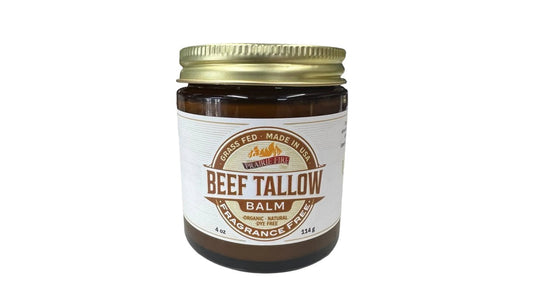
Grass Fed Beef Tallow Balm 4 oz – Organic Natural Skin Moisturizer for Face →
- Active acne with cystic breakouts: Tallow is highly occlusive. On skin that is already clogging, a rich fat layer can make things worse before it makes them better. Patch test on the jawline, not the whole face.
- Seborrheic dermatitis: The yeast involved in seborrheic dermatitis feeds on oils, including tallow. Many dermatologists advise against heavy oil-based balms on affected areas.
- Known beef or dairy allergy: Tallow is rendered beef fat. If you react to beef protein, talk to a clinician before using it on your skin.
- Very oily skin in humid climates: A water-free balm can feel heavy. A lighter carrier oil may be a better fit.
If none of those apply, tallow balm is generally well tolerated; start with the fragrance-free version.
Watch Out
Do not assume "natural" means gentle. Essential oils are natural and are one of the most common triggers for reactive skin. If you have reacted to botanical products before, start with the fragrance-free jar, not a scented one.
Tallow Balm for Face: Texture, Absorption, and What to Expect
Tallow balm for face works best as the last step in a short routine. It arrives solid and melts on contact into a thin oil within seconds.

Absorption depends on how much you use. A pea-sized amount for the whole face sinks in within minutes; a fingertip scoop leaves a shine for an hour. Start smaller than feels right.
What to expect over the first two weeks:
- Day one: skin feels soft, possibly slightly tacky for the first ten minutes
- Week one: dryness on cheeks and around the nose typically eases
- Week two: most users settle into a routine of once at night, sometimes again in the morning
The balm is rich in vitamins A, D, E, and K, which occur naturally in grass-fed tallow, and its fatty acids sit close to the oils your skin already produces, which is why it absorbs rather than sitting on top.
How to Use Tallow Balm on Face and Body
Learning how to use tallow balm takes about a minute, and the technique is the same for face and body.
- Wash your face or the area you are treating, then pat dry.
- Leave the skin slightly damp. Damp skin helps the balm seal in moisture.
- Warm a pea-sized amount between your fingertips until it turns to oil.
- Press and massage it into the skin in upward strokes.
- Add a second thin layer on cracked heels, elbows, or dry patches.
- Use it at night for the face, and any time for hands and body.
Beyond the face, the same jar handles dry hands, cracked heels and elbows, beard conditioning, after-sun care, and winter windburn, the argument for buying the 8 oz.
Key Takeaway
Apply to damp skin, not dry skin. The balm is an occlusive, meaning it holds moisture in rather than adding water. Water first, balm second, and the result is noticeably better.
Packaging, Shelf Life, and Storage
Tallow balm is naturally shelf stable because it contains no water, and Prairie Fire packs it in jars rather than tubes or pumps.
Tubes expose product to air with every use; a jar lets you take exactly what you need with clean fingers or a small spoon.
Storage rules are simple:
- Keep the lid closed between uses
- Store at room temperature, below about 75°F
- Skip the refrigerator unless your home runs hot in summer
- Use clean hands or a dedicated spoon to avoid introducing bacteria
A jar stored this way holds its texture for a long time. If the balm separates slightly in warm weather, stir it and it will firm back up.
Where to Buy Organic Grass Fed Tallow Balm
You can buy organic grass fed tallow balm directly from Prairie Fire Candles, and buying direct is better for one reason: you can ask the maker questions.
The three sizes are all one-time purchases, no subscription required:
- Grass Fed Beef Tallow Balm 2 oz at $19.99 for a first trial
- Grass Fed Beef Tallow Balm 4 oz at $25.99 for face-only routines
- Grass Fed Beef Tallow Balm 8 oz at $35.99 for full-body use and the lowest cost per ounce
Switching from another tallow balm? Expect a firmer, less greasy texture. From a water-based lotion?
For shoppers weighing animal-based against plant-based skincare, the FDA guidance on cosmetics and animal-derived ingredients and the American Academy of Dermatology on moisturizing are both worth a read before you commit to a routine.
Finding a moisturizer that does not trigger a reaction is the hard part, and most people burn through a shelf of failed jars first.
Frequently Asked Questions
What should I look for when buying organic grass fed tallow balm?
Start with the ingredient list. A simple formula should name grass-fed beef tallow and a carrier oil like cold pressed extra virgin olive oil, nothing else unless you want essential oils for scent. Check that the tallow comes from cattle raised on pasture, and that the balm is dye free and paraben free. Prairie Fire's balm lists only two core ingredients and is rendered in small batches, which makes the sourcing easy to trace.
Is unscented tallow balm better for sensitive skin?
For reactive or allergy-prone skin, a fragrance free tallow balm removes one common trigger. Prairie Fire offers both fragrance free options and versions with therapeutic essential oils like lavender or frankincense. Note the difference: fragrance free means nothing is added to create or mask a scent, while unscented products sometimes use masking agents. If your skin reacts easily, start with the fragrance free version and patch test a small area before applying it more widely.
Can you use grass fed tallow balm on your face and body?
Yes. Prairie Fire's tallow balm is sold as a face and body moisturizer, and the listing names uses including face moisturizer, hand moisturizer, dry skin treatment, beard balm, and cracked heels and elbows. For the face, a pea-sized amount is typically enough. Because the balm is concentrated, the same jar can cover both routines, which is part of why the larger sizes work out cheaper per ounce.
Why are some dermatologists cautious about tallow balm?
The caution usually centers on occlusive, oil-based formulas: they seal in moisture well but can feel heavy or contribute to clogged pores on acne-prone skin. Tallow's fatty acid profile is close to human skin oils, which is why many dry and sensitive skin users tolerate it well. If you are prone to breakouts, patch test on your jawline first and apply a thin layer rather than a thick one.
How long does a jar of tallow balm last, and how should I store it?
Because the balm is concentrated and contains no water, Prairie Fire notes that most customers find an 8 oz jar lasts significantly longer than typical lotions. Pure tallow is naturally shelf stable. Store your jar in a cool, dry spot away from direct sunlight, keep the lid closed between uses, and avoid introducing water into the jar, since water is what causes water-based lotions to need preservatives in the first place.
Tags:
Related articles
How to Soothe Eczema with Tallow: A Gentle Guide
Oct 01 2026
Grass-Fed Beef Tallow for Skin: A How-To Guide
Sep 30 2026