

Why Non Toxic Candles Are Expensive: 2026 Price Guide
Table of Contents
- Why Non Toxic Candles Are Expensive: The Real Cost Breakdown
- Why Are Paraffin Candles Bad for You? The Cheap Wax Trade-Off
- Benefits of Soy vs Beeswax Candles: Which Clean Wax Costs More
- How to Identify Phthalate-Free Candles Before You Buy
- Cost Per Burn Hour: The Math Big Brands Don't Show You
- Soot, VOCs, and Indoor Air Quality: What the Label Won't Tell You
- Conclusion: Paying for What You Breathe
- Frequently Asked Questions
Last Updated: October 4, 2026
Why Non Toxic Candles Are Expensive: The Real Cost Breakdown
Non toxic candles are more expensive because their raw materials cost more, their production runs are smaller, and their testing and labeling requirements are stricter than mass-market alternatives. At Prairie Fire Candles, we pour every candle by hand on our family farm in Paxico, KS, which means we feel those costs directly. A paraffin candle from a big-box shelf can sell for a few dollars because petroleum wax is cheap and factories produce millions of units at once. A clean-burning candle made with American soy wax, a lead-free cotton wick, and phthalate-free fragrance simply cannot compete on that price. Below, we break down exactly where your money goes, and why the gap is smaller than it looks once you measure cost per burn hour.


What 'Non-Toxic' Actually Means on a Label
Here is the uncomfortable truth: "non-toxic" is a marketing term, not a regulated one. No federal agency certifies a candle as non-toxic, so any brand can print it on a jar. What the phrase should mean is that the candle avoids petroleum-based paraffin, lead and zinc wicks, phthalates, parabens, and added dyes. The Consumer Product Safety Commission guidance on candle safety covers burn safety and labeling, but it does not define "non-toxic" for you. That gap is why you have to read ingredient lists yourself instead of trusting the front of the label.
Watch Out
A candle labeled "natural" can still contain synthetic fragrance and paraffin blended into the wax. If the label does not name the wax type and the fragrance source, assume neither is clean.
Why Are Paraffin Candles Bad for You? The Cheap Wax Trade-Off
Paraffin wax is a petroleum byproduct, and it is the single biggest reason cheap candles are cheap. It holds fragrance well, throws scent hard, and costs a fraction of soy, coconut, or beeswax. The trade-off shows up in what it releases when it burns. Paraffin can emit soot and volatile organic compounds, the same class of airborne particles that EPA indoor air quality research links to respiratory irritation in sensitive people. That matters if you get migraines or have allergies. It is not a reason to panic about every candle in your house, but it is a reason the wax type belongs on your radar. Soy and beeswax burn cleaner and cooler, and that difference is baked into their price.
Benefits of Soy vs Beeswax Candles: Which Clean Wax Costs More
Soy wax is the more affordable clean option, while beeswax typically costs the most of the natural waxes. Both beat paraffin on soot and both come from renewable sources, but they behave differently in the jar, and the reasons behind the price gap come down to how each wax is sourced, refined, and blended.
Soy wax starts as soybean oil pressed from a commodity crop. The oil is hydrogenated to raise its melting point, which is what turns a liquid oil into a solid wax that can hold a wick and a melt pool. Because soybeans are grown at scale across the Midwest, the base oil is widely available and priced on a relatively stable commodity market.
Beeswax is a different story. It is a byproduct of honey production, not a crop, so supply depends on hive health, weather, forage, and colony losses. A bad season for bees means less wax on the market, and the price moves accordingly. Beekeepers also have to render and filter the wax, which adds labor that soy processing does not require.
Coconut wax is the wildcard. It is soft and low-melting on its own, so it is almost always blended with soy or another harder wax to improve hot throw and create a smoother top. Coconut oil is imported, which adds freight and tariff exposure to its cost, and that is part of why coconut blends land in the moderate-to-high tier even though the wax itself burns cleanly.
| Wax Type | Relative Cost | Soot Level | Best For |
|---|---|---|---|
| Paraffin | Lowest | Highest | Strongest scent throw on a budget |
| Soy | Moderate | Low | Everyday clean burning |
| Coconut blend | Moderate to high | Low | Smooth hot throw |
| Beeswax | Highest | Lowest | Slow burn, natural honey scent |
Pro Tip
If a candle lists "soy blend" without naming the other wax, ask what it is blended with. A soy-paraffin blend costs the maker less than pure soy but can still be marketed as a soy candle.
A common pattern among small makers is to pour pure soy for everyday scents and reserve beeswax for limited runs, because the beeswax price swing makes it hard to hold a stable retail price year-round. That sourcing reality, not marketing, is the main driver of the price difference you see on the shelf.
How to Identify Phthalate-Free Candles Before You Buy
Phthalate-free candles name their fragrance source and avoid the plasticizers used to stretch synthetic scent. Phthalates are the chemicals that make a fragrance last longer and throw farther, and they are the ingredient most often flagged by people with sensitivities. But here is the part most buying guides skip: the phrase "phthalate-free" is not a regulated claim, and neither is "non-toxic." No federal agency certifies either one for candles, so the only way to verify a claim is to trace it back to the fragrance supplier.
That is where supply-chain transparency becomes the real test. Fragrance oils come in two broad categories, and their cost difference is a major reason clean candles cost more:
- Synthetic fragrance oils are built from petrochemical feedstocks in a lab. They are cheap, consistent, and available in an unlimited range of scents. A single synthetic accord can cost a maker a fraction of what the natural equivalent costs per ounce.
- Essential oils are distilled from plant material. The yield is tiny, the harvest is seasonal, and the price swings with crop conditions. It can take hundreds of pounds of lavender or peppermint to produce a small quantity of oil, which is why a true essential-oil candle carries a higher price.
- Fine fragrance oils sit in between. They are blended synthetics made to a higher standard, often without phthalates, and they cost more than commodity synthetics but less than pure essential oils.
When a brand says "phthalate-free," the meaningful question is which of those three it uses and whether it will name the supplier. A maker who publishes a full ingredient list, names the fragrance house, and can tell you the IFRA (International Fragrance Association) compliance status of a scent is giving you something verifiable. A maker who only prints "clean fragrance" on the front of the jar is not.
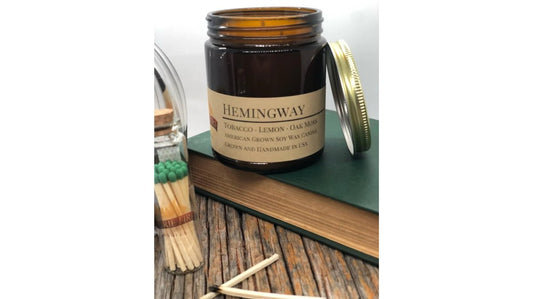
Hemingway Soy Wax Candle | 9 oz Amber Apothecary Jar →
Here is a thirty-second checklist that goes past the label:
- Check the label for "phthalate-free" and "paraben-free" as explicit claims, not implied ones
- Look for "essential oils" or "fine fragrance oil" instead of just "fragrance"
- Confirm the wick is cotton, and lead-free and zinc-free
- Scan for added dyes; clean candles are usually undyed
- Search the brand's site for a full ingredient list, not just scent notes
- Look for a named fragrance supplier or an IFRA compliance statement
- Check whether the brand discloses its wax source and wick supplier
Watch Out
"Fragrance" on an ingredient list is a legal catch-all that can hide dozens of individual compounds, including phthalates. If a brand will not break that term down, you cannot verify the phthalate-free claim from the label alone.
Our Hemingway Soy Wax Candle lists its wax, wick, and fragrance claims right on the product page, because we think you should not have to guess. The broader point is that transparency, not the word "non-toxic," is what actually tells you whether a candle is clean.
Cost Per Burn Hour: The Math Big Brands Don't Show You
Cost per burn hour is the sticker price divided by the total burn time, and it is the number that actually tells you which candle is expensive. A cheap paraffin candle may burn for a short time and tunnel down the middle, wasting wax. A well-made soy candle burns slowly and evenly, so each hour costs less than the sticker suggests. Run the math on any candle before you decide it is overpriced:
Cost per burn hour = Price ÷ Total burn hours
If a candle costs $19.99 and burns for 50+ hours, that works out to roughly 40 cents per hour. A discount candle that burns out in 15 hours at $8 costs about 53 cents per hour and smells like chemicals the whole time. The "expensive" candle is the cheaper one per hour of actual use. That is the math the big brands leave off the shelf tag.
Pro Tip
Trim your wick to 1/4 inch before every burn. An untrimmed wick burns hot, soots the jar, and can cut total burn time significantly. A Candle Wick Trimmer makes this a two-second habit.
Soot, VOCs, and Indoor Air Quality: What the Label Won't Tell You
Soot and VOCs are the invisible costs of a cheap candle, and no label warns you about them. Soot is the black residue that forms when a candle burns inefficiently, and VOCs are the carbon-based gases released as wax and fragrance break down. In a sealed room, those particles accumulate. A long, un-trimmed wick or a paraffin-heavy blend makes both worse. This is where the chemistry matters to your decision: a cotton wick, a clean wax, and a proper melt pool all reduce what ends up in your air. If you or anyone in your home has asthma, allergies, or scent-triggered migraines, that difference is the whole point of paying more.

Key Takeaway
The real question is not whether a candle is expensive. It is whether it burns cleanly enough to sit in your home for hours. Cost per burn hour, wax type, and wick material answer that better than the price tag.
Conclusion: Paying for What You Breathe
The gap between a discount candle and a clean one comes down to petroleum wax, synthetic fragrance, and factory scale, and every one of those savings lands in the air you breathe. We built Prairie Fire Candles around the opposite trade-off: 100% American soy wax, lead-free and zinc-free cotton wicks, and phthalate-free and paraben-free fragrance, all hand-poured on our family farm in Paxico, KS. Our candles and soy wax melts are made without added dyes, paraffin, or harmful additives, so you can light one without second-guessing the label. Add to Cart.
Frequently Asked Questions
Are there any truly non-toxic candles?
Yes, but the label alone won't prove it. A genuinely non-toxic candle uses clean wax such as 100% soy, coconut, or beeswax, a cotton or wood wick that is lead-free and zinc-free, and fragrance that is phthalate-free and paraben-free. Prairie Fire Candles' Hemingway Soy Wax Candle, for example, lists all of this on the product page: 100% American soy wax, braided cotton wick, and phthalate-free, paraben-free fragrance. If a brand won't publish those details, treat the claim as marketing.
Why are candles so expensive right now?
Several costs stack up at once. Clean waxes like soy and beeswax cost more per pound than petroleum-based paraffin, phthalate-free fragrance oils run higher than synthetic blends, and small-batch makers hand-pour rather than run automated lines. Add cotton wicks, glass jars, labels, and shipping, and a 9 oz candle can carry $8 to $12 in materials alone. That's why a non-toxic candle often lands between $18 and $30 while a mass-market paraffin candle sells for $6.
What ingredients make a candle non-toxic?
Four things matter most: the wax (soy, coconut, beeswax, or a clean blend instead of paraffin), the wick (cotton, wood, or another lead-free and zinc-free option), the fragrance (phthalate-free and paraben-free oils or essential oils), and the absence of added dyes. Prairie Fire Candles' soy wax melts follow this same formula: 100% American-grown soy wax, phthalate-free and paraben-free fragrance, and no added dyes, lead, zinc, chemicals, or paraffin.
How long do non-toxic candles actually burn?
Burn time depends on wax, wick, and jar size, not on price alone. A 9 oz soy candle with a properly trimmed cotton wick typically runs 50 or more hours. Prairie Fire Candles lists 50+ hours for its 9 oz Hemingway Soy Wax Candle. To get that full burn, trim the wick to 1/4 inch before every use and let the melt pool reach the full width of the jar before you blow it out.
Tags:
Previous
How to Soothe Eczema with Tallow: A Gentle Guide
Next
Buy Organic Grass Fed Tallow Balm: A 2026 Review Guide
Related articles
How to Understand Why Artisan Candles Cost More
Oct 24 2026
Tallow Balm vs Plant-Based Oils: Which to Choose
Oct 20 2026
Primally Pure Alternative for Sensitive Skin
Oct 12 2026